

How we redesigned the three break points in the prepaid journey
Context & Problem
At Claro, every time a prepaid customer can't resolve something in the digital channel, they call the contact center, or simply give up. We mapped the three key moments where this breakdown happens across the prepaid customer lifecycle and redesigned each one as a focused initiative.
The through-line is a single KR: reduce reliance on human support, increase self-service resolution in the digital channel, and let customers solve on their own what they currently offload to an agent.
My role
Product Designer embedded in Claro's prepaid mobile squad. I led discovery, research synthesis, and design across all three initiatives, from field research with retailers to director-level presentations and final interaction design in Figma.
Initiatives
- New SIM Activation
- Emergency Balance
- Line Status
What we move
- Task completion rate
- Support deflection rate
- Contact rate

Three different initiatives that solve the same problem: the prepaid lifecycle breaking at the points where the customer is left without a digital way out. Each one below repairs a different break point, all moving the same KR.
Break point 01
New SIM Activation
The first interaction that didn't work
Context
Prepaid SIM activation is the moment a customer enters Claro's base, and the opportunity to make them digital from day one. With millions of activation attempts per year and a low-single-digit conversion baseline, it's a high-volume journey with critical (and largely unrealized) impact.
Key insight
Field research with retailers in three cities revealed that the problem was structural, not just an interface issue: the poor interface was a symptom. The journey, fragmented across multiple environments, leaked users at every channel handoff, and the audience, mostly lower-income segments with low digital literacy, was disproportionately penalized by each point of friction.
Details
How might we redesign the prepaid activation journey so the customer can activate their line fully digitally, without channel deflection to human support, even under unstable network conditions and low digital literacy?
Hypothesis
- Early Validation: Anticipate eligibility validations by crossing CPF and biometrics to reduce late drop-offs in the activation flow.
- Visual-first approach: Prioritize visual elements over explanatory text to improve comprehension for the C/D audience with low literacy.
- Connection Resilience: Allow the user to resume the flow from where they left off, recovering customers who drop off due to network instability.
- Digital credential: If we create the Minha Claro credential right after biometrics, the customer becomes digital from their very first interaction
Value props
Activate first, add complexity later. Less text, more visuals. Resume from where you left off in case of a network drop.
Project phases
The project was structured in phases. Phase 1 covers the full new journey with biometrics and in-housing of the flow. Later phases evolve into native top-up and eSIM.
Solution
A full redesign of the journey: upfront eligibility screening (so customers don't discover a block late in the flow), 100% mandatory biometrics, removal of the dependency on the external environment, and creation of a Minha Claro credential at the end of activation, so the customer is born digital on their very first interaction.
-
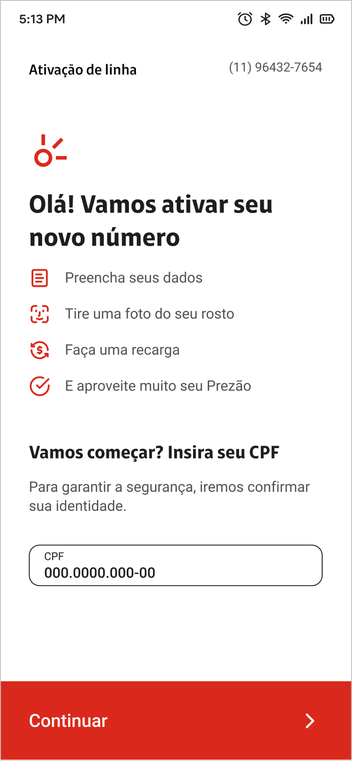
Eligibility is resolved before the customer commits time to the flow. If something blocks activation, the system catches it upfront, not three steps in. -
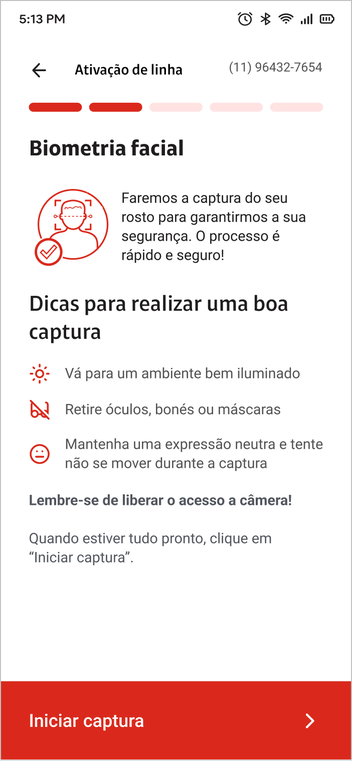
Progress indicators and visual-first steps reduce cognitive load for users with limited digital literacy, the core audience for prepaid. -
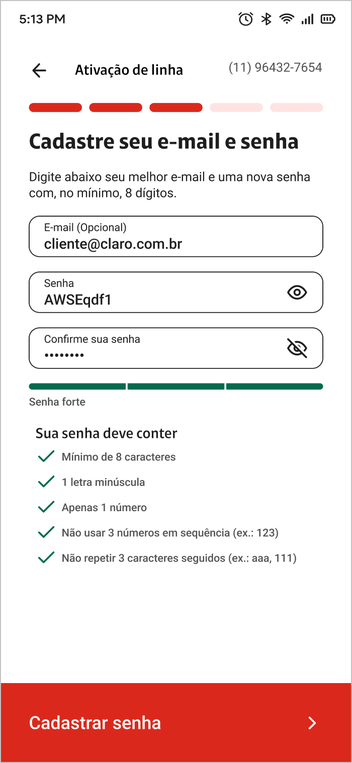
At the moment of biometric confirmation, the customer creates their Minha Claro credentials. They exit the flow already inside the digital ecosystem. -
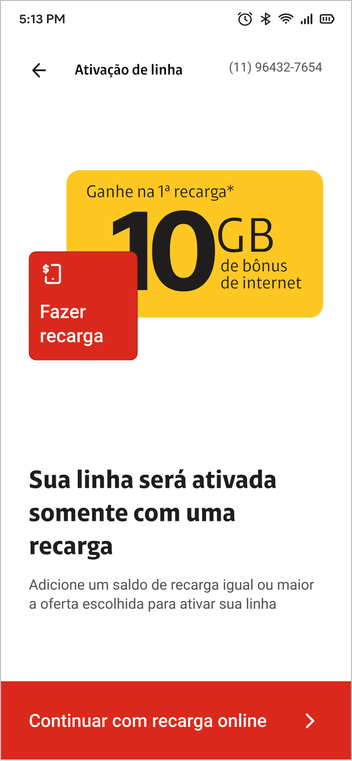
Deliberate redundancy in critical warnings: comprehension before progression. -
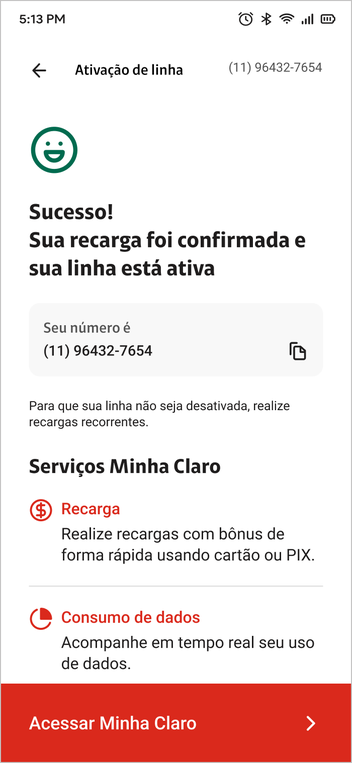
Activation is confirmed with the line number visible and status unambiguous. No 'wait 24 hours', just a working line. -
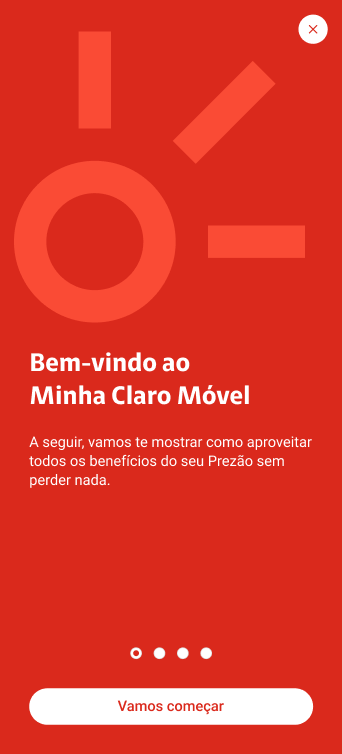
The final step introduces Minha Claro's core features. The customer leaves knowing what they now have access to.


Projected potential
The new journey went live in July 2026 and we're currently measuring performance. Starting from a low-single-digit conversion baseline, the estimate is a projected multi-fold increase in conversion, with the potential to bring a large monthly volume of new users into the digital ecosystem each month. Elimination of the third-party vendor cost. Regulatory compliance with Anatel's requirement.
Break point 02
Emergency Balance
The moment the customer gets stranded
Context & Problem
There's a specific moment when a prepaid customer is in the middle of something important (paying a bill, checking their plan, or just browsing) and realizes their data allowance has run out. In some situations, they can't top up right away. Without a safety net, the channel loses the customer, and the contact center gains a call.
Claro already offered Claro Conecta, SOS Recarga, and early plan renewal (Antecipação de Renovação). But for a customer who ran out of data or credit in the middle of a task, those names meant nothing, let alone which one to use in that moment.
Solution
Instead of surfacing the three technical products upfront, we built a situation-based decision layer. The customer describes what's happening ("my plan ran out earlier than expected," "I'm out of data," "I'm out of credit") and the interface recommends and triggers the right solution. The product takes on responsibility that used to fall on the customer. The name "Emergency balance" is part of the solution: a single entry point, framed by situation, not by product.


Impact
Fewer incorrect uses of the emergency features. Less drop-off in the moment of crisis. Customers now resolve in the channel what used to turn into a call because they didn't know which product to trigger.
One notable side effect: a drop in "Claro ate my credit" complaints. A meaningful share of those came from customers who had triggered the credit loan without realizing it, only discovering the charge on their next top-up. With the decision layer making explicit what's being taken on, customers go in aware. Less surprise, less distrust, fewer complaints.
Break point 03
Line Status
The warning that came in time
Context & Problem
In prepaid, 120 days without a top-up result in a blocked line. This simple moment is one of the biggest drivers of contact with human support: the customer doesn't know their line status, can't resolve it on their own, and calls in.
Line status was a blind spot: prepaid customers had no alert about an upcoming suspension: they only found out about the situation after losing service, which generated recurring volume in the contact center.
Solution
We added line status alerts directly in the web dashboard, with a direct shortcut to top-up. By surfacing the warning before the suspension happened, more customers acted in time, without needing to call.


Impact
Fewer contacts related to line suspension. Higher task completion rate for this segment. More customers resolving on their own a moment that, before, inevitably led to a call.
Why they work together
- New SIM Activation → entering the digital base
- Emergency balance → staying connected when it runs out
- Line status → acting before the line is gone
This isn't a collection of three prepaid projects. It's the mapping of the break points across an entire customer lifecycle, with one initiative for each. Three initiatives. One KR.